

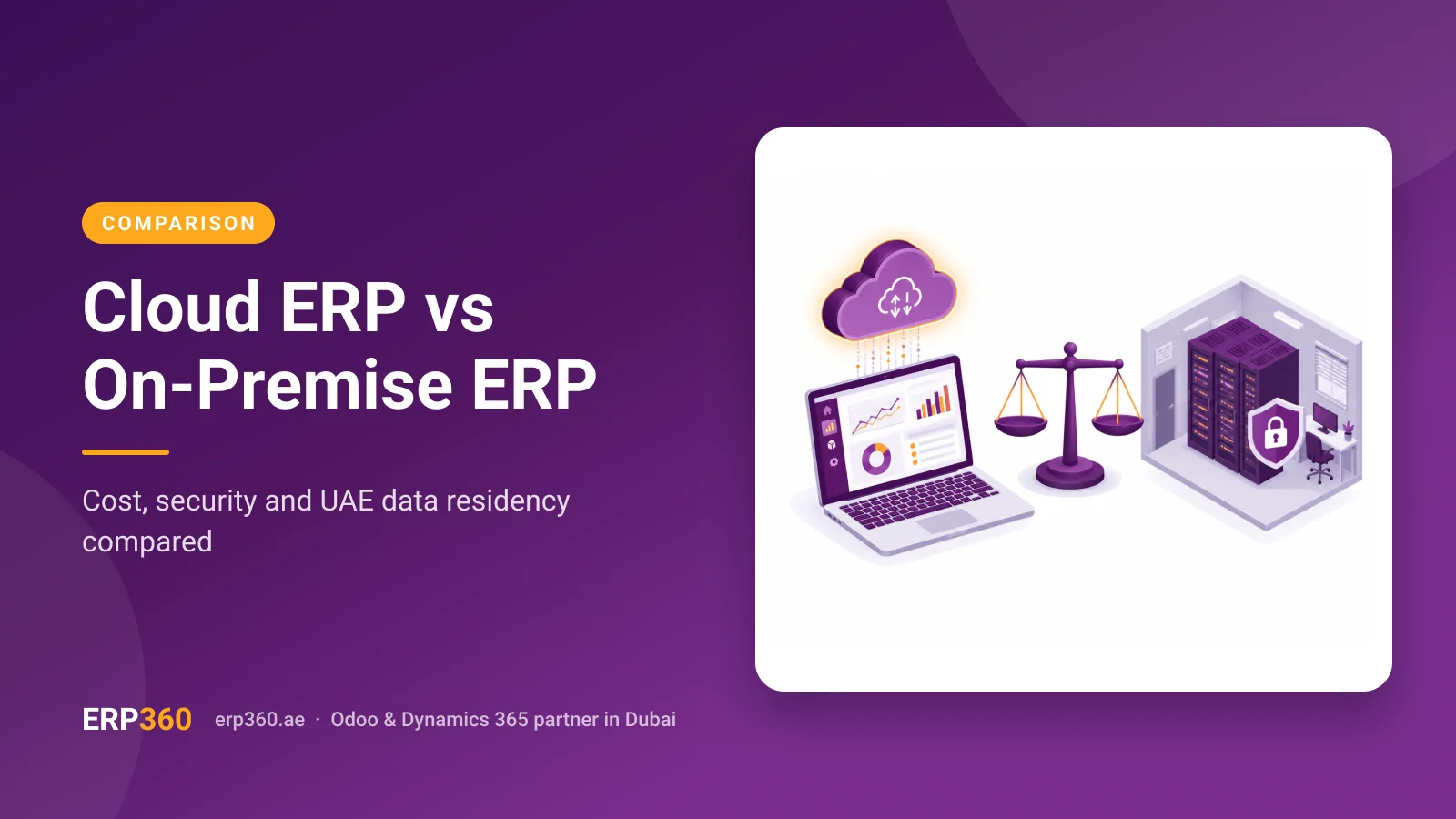
For most UAE businesses, the cloud ERP vs on-premise ERP decision comes down to where your data must physically sit and who you want running the servers. Get those two answers right and the model picks itself. This guide shows you how to answer them for your own data, rules and budget.
01What is the difference between cloud ERP and on-premise ERP?
Cloud ERP is enterprise resource planning software that runs on servers a provider operates and that your team reaches through a browser. You pay a subscription, and the provider handles the hardware, patching and backups.
On-premise ERP is ERP software installed on servers your company owns or controls. You buy or license the software, run the infrastructure, and carry the upgrades, security and disaster recovery yourself.
The software can be identical in both cases. Odoo and Microsoft Dynamics 365 Business Central, for example, both come in cloud and self-hosted forms. What changes is who carries the operational work, how fast new versions arrive, and where your records live.
02Cloud ERP vs on-premise ERP: the side-by-side comparison
The table covers the factors every buyer weighs. The UAE-specific question, data location, gets its own section further down because it decides more deals than this whole table.
| Factor | Cloud ERP | On-premise ERP |
|---|---|---|
| Upfront cost | Low. No servers to buy | High. Hardware, licences, setup |
| Ongoing cost | Subscription per user or plan | Maintenance, IT staff, hardware refresh |
| Time to go live | Faster. Infrastructure already exists | Slower. Servers must be built first |
| Updates | Provider rolls them out on its schedule | You choose when, and you do the work |
| Customization | Limited to what the provider permits | Full control, including custom code |
| Security work | Shared. Provider secures the platform | Entirely yours |
| Access | Anywhere with internet | Office network, or VPN for remote staff |
| Internet outage | Users lose access | Local users keep working |
| Data location | Wherever the provider hosts it | Wherever you put the server |
That leaves the advantages and disadvantages of cloud ERP in one line: you trade control for speed and lower operational effort. On-premise makes the opposite trade. The rest of this guide is about the conditions that tip that trade one way or the other.
03Why "cloud" is really four different choices in the UAE
Most comparisons of cloud ERP vs on-premise ERP treat cloud as one option. In practice, UAE buyers choose between four models, and each one answers "where is my data and who runs it?" differently.
| Model | Who runs the infrastructure | Who picks the data location | Custom code | Example |
|---|---|---|---|---|
| Vendor SaaS | Vendor | Vendor | Limited | Odoo Online, Business Central online |
| Vendor-managed platform | Vendor | Vendor | Yes | Odoo.sh |
| Private cloud in a UAE region | You or your partner | You | Yes | Odoo in your own AWS or Azure account |
| True on-premise | You | You | Yes | Odoo or Dynamics on your own servers |
Vendor SaaS
The software vendor hosts a shared, standard platform. Odoo Online and Business Central online are examples. Setup is fastest and IT effort is lowest, but the vendor decides the hosting region and the upgrade calendar.
Vendor-managed platform
The vendor still runs the infrastructure, but you get your own environment and can deploy custom code. Odoo.sh is the clearest example. You keep developer freedom without managing servers, yet hosting location remains the vendor's call.
Private cloud ERP in a UAE region
Private cloud ERP means the ERP runs on cloud infrastructure in an account your company owns, in a region you choose. Microsoft, AWS and Oracle all operate cloud regions inside the UAE. You get cloud elasticity and remote access, plus the residency certainty of picking a UAE data centre yourself.
This is the model most comparisons skip, and it often resolves the whole debate. ERP360 has deployed Odoo on AWS for clients this way, with the account held and paid for by the client and our team building and supporting the system inside it.
True on-premise
Servers sit in your own building or a colocation rack you control. It is the right answer when systems must keep running without internet, or when a contract or regulator demands physical custody. It is the most expensive model to run well, because backup, patching and recovery testing all land on your team.
Where Odoo's three hosting options fit
The question of Odoo Online vs Odoo.sh vs on-premise maps neatly onto these models. Odoo's own hosting guidance positions Odoo Online for standard configurations without custom Python modules, Odoo.sh for businesses that need custom modules, and on-premise for full control of code and infrastructure. Odoo partners commonly class Odoo installed in your own cloud account as on-premise too, which is how the UAE-region private cloud model works in practice. Settle the hosting choice during Odoo ERP implementation scoping, because moving later means a data migration.
04ERP data residency UAE: which rules apply to your data?
ERP data residency in the UAE is not one rule, and for many firms it is where the cloud ERP vs on-premise ERP question actually gets settled. It depends on what kind of data sits in the system, and the answer can differ for invoices, staff records and patient files held in the same database.
Tax and e-invoicing records
The Ministry of Finance's e-invoicing guidelines state that invoice data may be stored inside or outside the UAE, including in cloud environments. The conditions are that records stay complete and unaltered and that the Federal Tax Authority can reach them promptly. FTA Decision No. 4 of 2026 adds that electronically kept accounting records must be complete, legible and accessible to the FTA on request, including any passwords or encryption keys.
The practical point is responsibility. The guidance is clear that outsourcing storage to a cloud provider does not move legal responsibility away from the business.
Personal data under the PDPL
Federal Decree-Law No. 45 of 2021, the UAE's Personal Data Protection Law, does not require all personal data to stay in the country. Its cross-border articles allow transfers to countries with adequate protection, or under specific listed conditions where that protection is missing. Companies in the DIFC and ADGM fall under those free zones' own data protection laws instead, so a group spanning mainland and a financial free zone may face two regimes.
Health data
This is the strictest category. Article 13 of Federal Law No. 2 of 2019 on ICT in health fields prohibits storing or processing health data from UAE health services outside the country.
Ministerial Decision No. 51 of 2021 created a defined list of exceptions. Any clinic, pharmacy or health insurer putting patient-linked data into healthcare ERP software should treat UAE hosting as the default and check exceptions with a legal adviser.
Banks, insurers and other regulated finance
The Central Bank of the UAE has issued cloud computing guidance for licensed financial institutions that covers outsourcing risk, oversight of providers and data residency. Licensed entities evaluating financial services ERP should read their regulator's requirements before choosing any model.
| Data class | Governing rule | What it means for your deployment |
|---|---|---|
| Invoices and tax records | MoF e-invoicing guidelines, FTA Decision No. 4 of 2026 | Offshore cloud can work if the FTA can access records on request |
| Employee and customer personal data | PDPL, or DIFC / ADGM law in those zones | Cross-border allowed with safeguards. Document where data flows |
| Patient and health data | Health Data Law, Article 13 | Keep it in the UAE unless a listed exception applies |
| Regulated financial data | CBUAE cloud guidance | Follow regulator requirements before signing |
The backup copy nobody asks about
Residency checks usually stop at the primary server, and that is where the gap opens. Odoo announced in 2024 that new SaaS and Odoo.sh customers in the MENA region would be hosted in Google's Dammam data centre in Saudi Arabia, not in the UAE. Odoo's Cloud SLA also states that backups are replicated to data centres in Europe and Canada, and that customers cannot choose or restrict the backup region.
For an invoicing workload, that may be perfectly acceptable. For health records, it is a problem before you have even gone live. Business Central behaves differently Microsoft lists the UAE as an available country, and administrators can see their environment's Azure region in the admin centre. Whichever platform you shortlist, ask where the backups go, not just where the database runs.
05Is on-premise ERP more secure than cloud ERP?
Not automatically, and this is the most misunderstood part of the cloud ERP vs on-premise ERP debate. On-premise gives you control, which is different from security. Control helps only if your team patches promptly, tests backups, monitors access and rehearses recovery. Many mid-sized companies own the server room but not the discipline.
Large cloud providers employ dedicated security teams and run redundant data centres. The weak points in cloud ERP tend to sit on the customer side instead: shared passwords, missing multi-factor authentication, and over-broad user roles. Either model can be secure, and either can fail. The honest question is which operating model your team can actually sustain.
06What really drives ERP cost over five years?
Subscription versus licence fees is the visible part of ERP total cost of ownership, and rarely the deciding part. These costs move the number more
- People. On-premise needs someone who owns servers, patching and backups. That salary often outweighs the subscription saving, which is why many firms hand the work to a managed Odoo ERP support team instead.
- Hardware refresh. Servers age out, and the replacement lands as a large one-off capital cost.
- Upgrades. Cloud upgrades are scheduled for you, while on-premise upgrades become projects your team has to fund and test.
- Customization debt. Heavy custom code raises upgrade cost in any model, but bites hardest on-premise, where nobody forces you to stay current.
- Downtime. An outage during VAT filing or month-end close costs more than most line items.
Model the full picture over at least five years before comparing cloud ERP vs on-premise ERP quotes. A cheap subscription with expensive workarounds can lose to a pricier platform that fits your processes.
07Where does hybrid ERP make sense?
Hybrid ERP splits one system landscape across more than one model. A common UAE pattern keeps patient or other sensitive records in a UAE-hosted environment while sales, CRM and reporting run in vendor cloud.
Hybrid earns its complexity when one data class has stricter rules than the rest. It also suits a staged move: keep the core on-premise while new modules go to the cloud, then migrate the core later. The cost is integration. Every boundary between models needs a connector that someone maintains, so keep the number of boundaries small.
08How to choose: a six-question worksheet
Answer these in order to settle cloud ERP vs on-premise ERP for your own business. The first question that produces a firm answer usually settles the model.
- Does any data legally have to stay in the UAE? If health data is involved, you need UAE hosting a private cloud in a UAE region or true on-premise.
- Where do the vendor's database and backups physically sit? If either falls outside what your rules allow, vendor SaaS is out for that workload.
- Do you need custom code? Yes points to a vendor-managed platform, private cloud or on-premise. No keeps vendor SaaS open.
- Must operations continue without internet? Factories, remote sites and warehouses with weak connectivity lean on-premise or hybrid.
- Who will run servers, patching and backups? If nobody, choose a model where the provider or a partner does.
- What does five-year total cost look like? Include people, upgrades and downtime, not just licences.
For most small and mid-sized UAE businesses without health data, the answers point to vendor SaaS or a vendor-managed platform. Companies with regulated data or heavy customization usually land on private cloud in a UAE region. Standing up servers in your own building is now the exception rather than the default. ERP360 implements both Odoo and Dynamics 365 in each of these models, through Odoo projects and Microsoft Dynamics consultancy, so the recommendation can follow your answers rather than a single product line.
09Key takeaways
- The cloud ERP vs on-premise ERP choice in the UAE turns on data location and operating responsibility more than on features.
- "Cloud" covers four models. Private cloud in a UAE region often gives residency certainty with cloud convenience.
- Tax records may sit offshore if the FTA can reach them. Health data generally must stay in the UAE.
- Check where backups go, not just the primary database.
- On-premise gives control, not automatic security. Choose the model your team can actually run.
Not sure which model fits your data? Talk to ERP360's consultants and map your workloads to the right deployment before you sign a licence.
10Frequently asked questions
These are the questions UAE finance and operations leads raise most often once a shortlist exists.
Is cloud ERP secure enough for UAE businesses?
Yes, for most workloads. Is cloud ERP secure? It is when the provider runs certified data centres and your team enforces multi-factor authentication and tight user roles. Check hosting and backup locations against the data rules that apply to you.
Which is better for a small business in Dubai?
In the cloud ERP vs on-premise ERP choice, cloud usually wins for small businesses. There are no servers to buy, there is no IT team to hire, and you can start with a few users and add more as you grow.
What happens to cloud ERP if the internet goes down?
Users lose access until connectivity returns. Sites where downtime is costly should add a backup internet line, or consider hybrid or on-premise for the operations that cannot stop.
Can we migrate on-premise ERP to cloud later?
Yes. To migrate on-premise ERP to cloud, plan data cleansing, custom code review and parallel testing before cutover. Moves between Odoo hosting types follow the same path as an Odoo upgrade and migration, and older Dynamics systems move through a planned Dynamics 365 migration.
Can we run cloud and on-premise ERP at the same time?
Yes. That is a hybrid setup. It works when the split follows a clear rule, such as keeping regulated data local, and when integrations between the two are kept to a minimum.
Do UAE VAT rules force us to use on-premise ERP?
No. Current e-invoicing guidance allows cloud and offshore storage, provided records stay intact and the FTA can access them promptly. Your business stays responsible for that access whichever provider hosts the data.