
ERP and CRM Reporting Services UAE One Set of Numbers for Sales and Finance
ERP and CRM reporting services UAE-wide turn two disconnected sets of figures into one: pipeline and deals from your CRM, invoices, costs and cash from your ERP. ERP and CRM reporting is a reporting service that defines every metric once and ties it to the system that owns it. ERP360 builds that layer on Odoo and Microsoft Dynamics 365, so sales forecasts, board packs and margin reports finally agree with the ledger, without a weekly Excel rebuild.
Our Process for ERP Reporting Services Dubai Teams Can Audit
Every engagement starts from the meetings your reports serve, not from a dashboard template. Below are the seven steps our ERP and CRM reporting services UAE-wide follow, from what leadership asks to reports that reconcile on their own.
Inventory the Reports You Actually Use
We collect every report circulated today, including the spreadsheets, and record who reads each one, how often and which decision it supports.
Write the Metric Dictionary
Each KPI gets one definition, one owning system, one date field and one rule for VAT and currency, agreed by sales and finance in writing.
Map Sources of Truth
We decide which figures come from the CRM, which come from the ERP and which must be joined, then document the matching keys between them.
Clean and Model the Data
Duplicate customers, missing analytic tags and inconsistent stages are fixed at source, so reports do not inherit errors that someone corrects by hand every month.
Build the Reports and Dashboards
We build in the platform's native reporting first and add a separate BI layer only where several systems genuinely have to be joined.
Reconcile and Sign Off
Every report is tied back to the trial balance and to CRM records, and any variance is explained before the business relies on it.
Hand Over, Schedule and Support
Reports are scheduled to the people who need them, users are trained to maintain filters and measures, and changes follow a simple request process.
What We're Selling: Six Reasons Teams Choose Us
These six commitments describe how we deliver reporting work, not which software we resell. Each one exists to stop the numbers drifting apart again.
One Metric Dictionary, Signed Off First
Every KPI gets a written definition, owning system and date field, approved by sales and finance before any dashboard exists.
CRM Reporting and Dashboards Built on Ledger Numbers
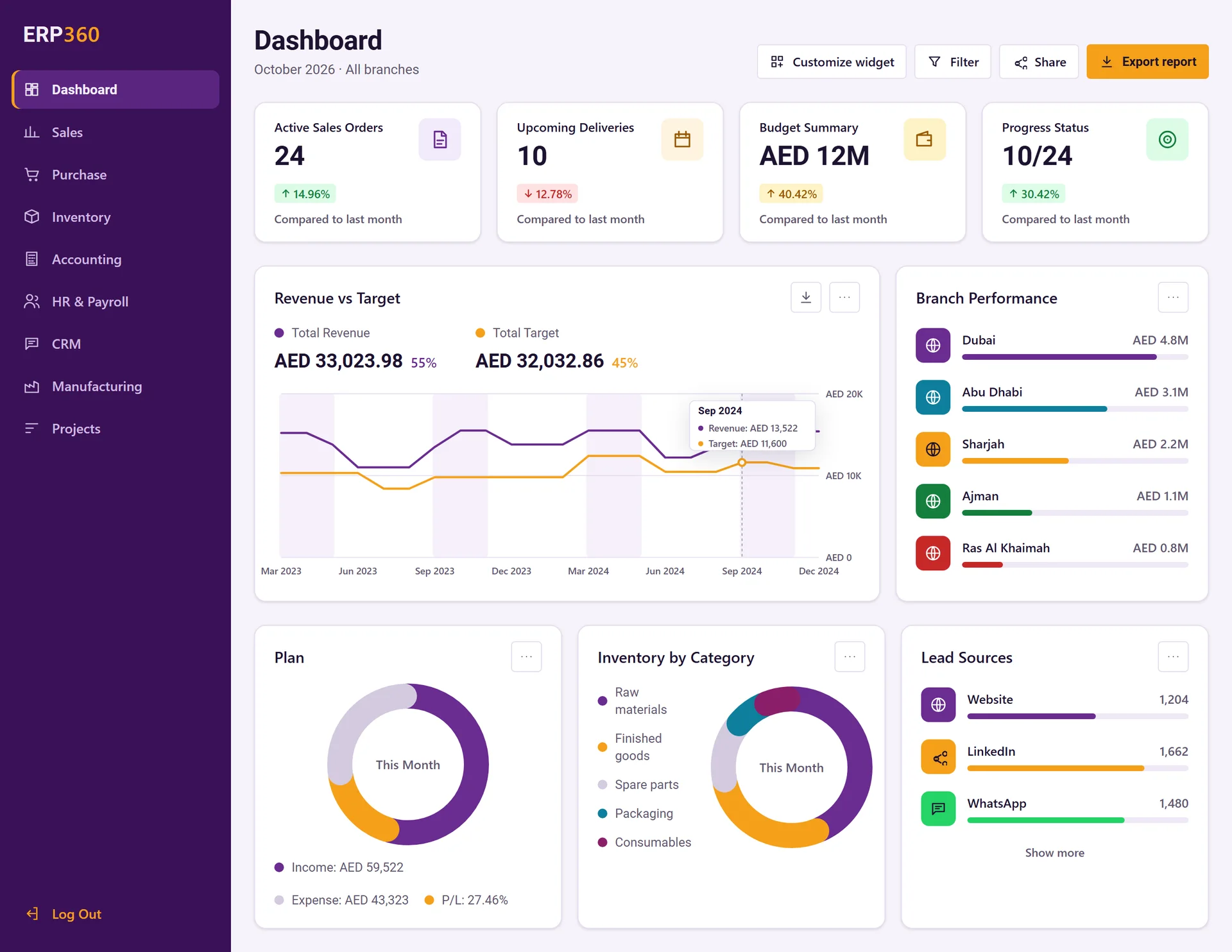
Sales dashboards show CRM pipeline beside invoiced and collected ERP figures, so targets are judged against revenue that actually landed.
Odoo and Dynamics 365 Under One Team
We report from both platforms, including mixed estates, so groups running each in different entities get one consolidated view.
Native Reporting Before Paid BI Licences
We use built-in Odoo and Dynamics reporting first and recommend separate BI tools only where several systems must be joined.
Reconciliation Built Into Every Handover
Before sign-off, each report is tied back to the trial balance and CRM records, with every remaining variance explained in writing.
Reports Your Own Team Can Maintain
Finance and sales users learn to edit filters, add measures and schedule exports, so small changes never wait on a developer.
CRM and ERP Data Reconciliation: Which System Owns Which Number?
Most reporting disputes are not software faults. They happen because the CRM and the ERP measure different moments in the life of a sale, and nobody wrote down which moment each report should use.
ERP360 starts every reporting engagement by fixing ownership, because a dashboard built on undefined metrics inherits the argument it was meant to settle. The table below is the starting map we agree with clients before any build. Agreeing it is the part of ERP and CRM reporting services UAE teams most often skip, and it is the part that settles the argument.
| Metric | Owning system | Date that defines it | Typical reason it disagrees |
|---|---|---|---|
| Pipeline value | CRM | Expected close date | Quotes entered VAT-inclusive while the ledger reports net of VAT |
| Bookings | CRM won deal or confirmed sales order | Confirmation date | Deals marked won before the order is confirmed in the ERP |
| Invoiced revenue | ERP | Invoice date | Exchange rate taken on the quote date in CRM but the invoice date in ERP |
| Cash collected | ERP | Payment date | Partial payments and credit notes that never appear in the CRM |
| Gross margin | ERP | Invoice or delivery date | Landed cost and discounts posted after the deal closed |
VAT Treatment Is the First Mismatch to Check
A salesperson often quotes the price a customer pays, while finance reports revenue before tax. Unless the metric dictionary states which basis each report uses, the two totals can never tie.
Currency Conversion Happens on Different Days
UAE businesses commonly quote in US dollars or euros and book in dirhams. If the CRM converts on the quote date and the ERP converts on the invoice date, every foreign-currency deal produces a small, permanent gap.
Entity Scope Decides What "Total" Means
A group with mainland and free-zone licences may run one CRM across all entities but keep separate ledgers. A group total in the CRM and a single-entity total in the ERP describe different businesses.
Ready for One Set of Numbers?
If your sales and finance teams bring different numbers to the same meeting, our ERP and CRM reporting services UAE teams can start with a report inventory and a metric dictionary.
Industries We Serve with Odoo ERP 360
The same reconciliation logic applies everywhere, but each sector cares about a different number. These are the reports we build first in each industry.
Rent roll, arrears ageing and occupancy reported per building, with CRM leasing pipeline beside service charges actually collected.
Project margin reports tying tendered BOQ value in CRM to certified progress billings, retention held and subcontractor costs.
Margin by supplier, SKU and customer including landed cost, so sales targets stop rewarding volume that quietly loses money.
Revenue by payer, separating insurance claims submitted, approved and rejected from self-pay income, with no clinical records exposed.
Order-to-delivery dashboards linking lead times promised in CRM quotes to work-order progress, scrap and actual production cost per job.
Channel sales across stores, website and marketplaces, reconciling discounts, returns and gateway settlements back to the ledger daily.
Supply Chain
Delivery-promise reports comparing requested dates with picks, shipments and freight cost for every order, route, lane and carrier.
Engagement profitability by client and partner, comparing proposal fees won in CRM with billable hours, write-offs and collections.
Benefits of ERP and CRM Reporting Services UAE Companies Can Measure
The benefits below come from the service itself, whoever delivers it. Each one answers a question finance or sales leadership asks every month.
Month-End Board Packs Without the Excel Rebuild
When reports pull from defined sources, the monthly pack stops being a spreadsheet project. This is where most MIS reporting Dubai teams lose their first week of every month. Automated packs give that time back to analysis.
Sales Targets Measured Against Collected Cash
Commission and target reports can show bookings, invoiced revenue and cash side by side. Sales leaders see which wins actually turned into money, and finance stops disputing the leaderboard.
Group Views Across Mainland and Free-Zone Entities
Consolidated reports respect each entity's ledger while giving owners one group view. Intercompany sales can be shown or eliminated, depending on who is reading the report.
Earlier Warning on Margin and Receivables
Dashboards that join deal data to invoices and payments show slipping margins and ageing receivables while there is still time to act, rather than at quarter end.
Audit-Ready Numbers With a Visible Trail
Because every figure traces to a defined field and source, auditors and tax advisers can follow a total back to transactions without asking finance to rebuild it.
Native Reports or a BI Layer? Odoo, Dynamics 365 and Mixed Estates
A separate business intelligence tool is not always the answer. For ERP and CRM reporting services UAE-wide, the right choice depends on how many systems hold your data, not on how impressive the dashboard looks.
On Odoo, pivot and graph views, Studio-built layouts and Odoo custom reports cover most needs when CRM, sales and accounting share one database, and our Odoo customization team handles the layouts native tools cannot produce. On Microsoft Dynamics 365, reporting usually runs through Power BI, which connects natively to Dynamics data; our Microsoft Dynamics consultancy scopes that work. Dynamics 365 reporting becomes a modelling job only when finance and sales apps sit on different environments.
| Your estate | Native reporting is usually enough when… | Add a BI layer when… |
|---|---|---|
| Odoo only | CRM, sales and accounting share one database | You need history from a retired system or external data |
| Dynamics 365 only | Sales and finance data sit in one environment | Several environments or legal entities need one model |
| Mixed (for example Odoo ERP with a separate CRM) | Rarely; the two systems share no keys | Almost always, starting with matched customer IDs |
When a warehouse or cross-system model is justified, our business intelligence services take over the data platform, while this service owns the metric definitions and reconciled reports that sit on top of it.
Key Takeaways on ERP and CRM Reporting
- Most CRM and ERP disagreements come from undefined metrics, not broken software.
- Decide which system owns pipeline, bookings, invoiced revenue, cash and margin, and which date defines each.
- In the UAE, check VAT basis, currency conversion dates and entity scope before blaming the data.
- Use native Odoo or Dynamics 365 tools first; add a BI layer only when systems must be joined.
- A report is finished when it reconciles to the ledger, not when it looks good.
If your sales and finance teams bring different numbers to the same meeting, our ERP and CRM reporting services UAE teams can start with a report inventory and a metric dictionary. Contact ERP360 to scope the first reconciled report pack.
FAQs
ERP and CRM reporting services UAE-wide cover report inventory, a written metric dictionary, source-of-truth mapping, data clean-up, report and dashboard builds, reconciliation against the ledger, scheduling and user training. Software licences and new system implementations are scoped separately.
Yes. Reporting reads from the systems you already run. If the two do not share customer or order keys, we add matching rules in the reporting layer; building a live sync between the systems is a separate integration project.
It means each metric has one owning system and one definition, so every report showing that metric returns the same figure. It is a governance rule first and a technology choice second.
Report automation generates and distributes recurring reports on a schedule. It replaces the manual cycle of exporting, pasting into spreadsheets, formatting and emailing the same pack every week or month.
It depends on how many systems are involved and how clean the data is. A single-system dashboard set is quicker than a multi-entity group pack, so we confirm the timeline after the report inventory rather than quoting one upfront.
Usually, yes, provided your transactions already live in an ERP or CRM. If they do not, fixing data capture comes first, because reporting cannot be more reliable than the records underneath it.
Finance controllers, sales leaders and owners use them most, typically in groups where sales and finance present different totals at the same monthly meeting.